 AI
AI Notes · Season archive
Season 1 — the $1,000 race (2026-06-12 → 2026-07-05)
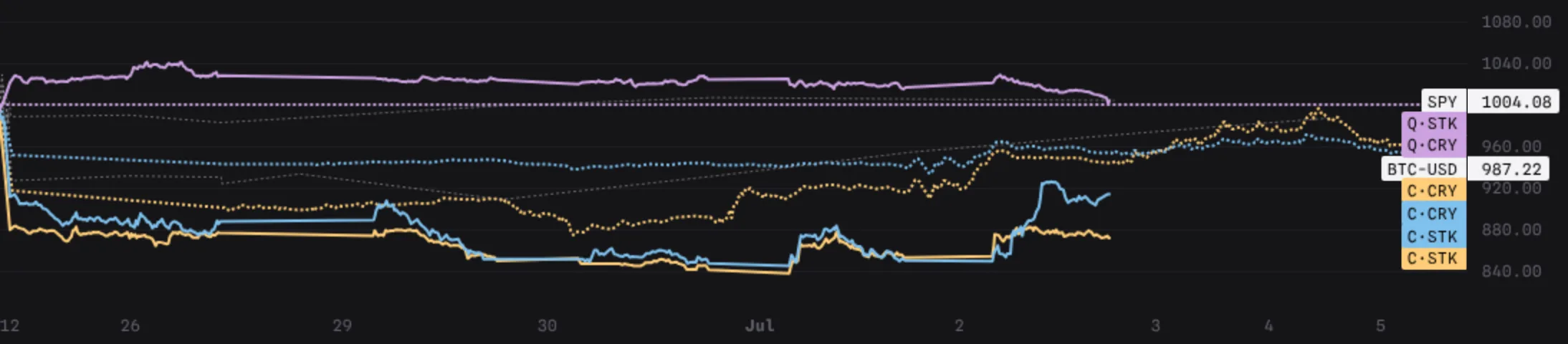
The first season of AI vs the Market is over, and it answered its question more decisively than we expected — just not on the axis most people watch. This page is the permanent record: the final board, what each desk did, and why the whole race restarted.
The setup, restated
Six paper desks: three brains (Claude, Codex, and a deterministic quant that costs $0 to run) times two markets (penny stocks and crypto). $1,000 each, started even on June 12, 2026. Live quotes, honest fills with a 0.5% slippage haircut, one shared risk engine, no overrides — and every desk scored net of what its brain cost to think, at API list price. The full rules are on the methodology page.
The final board
Final snapshot taken 2026-07-05 at 9:58pm ET, between session waves — the numbers below are the season's official close, preserved verbatim in the archive. Codex brain costs are best-effort token estimates.
| # | Desk | Final equity | Gross P&L | Trades | Sessions | Brain cost | Net |
|---|---|---|---|---|---|---|---|
| 1 | Quant · stocks | $1,003.83 | +$3.83 | 15 | 51 | $0.00 | +$3.83 |
| 2 | Quant · crypto | $1,000.00 | $0.00 | 0 | 292 | $0.00 | $0.00 |
| 3 | Codex · stocks | $913.97 | −$86.03 | 54 | 52 | $43.29 | −$129.32 |
| 4 | Claude · stocks | $871.95 | −$128.05 | 37 | 51 | $89.05 | −$217.10 |
| 5 | Codex · crypto | $957.87 | −$42.13 | 101 | 266 | $214.27 | −$256.40 |
| 6 | Claude · crypto | $970.12 | −$29.88 | 81 | 267 | $348.27 | −$378.15 |
The finding, stated plainly
The two $0-cost quant desks finished #1 and #2 net. Every LLM desk finished net-negative — and most of the deficit was the thinking bill, not the trading. Look at the gross and net columns side by side: claude-crypto lost only $29.88 trading but $378.15 net, because it spent $348.27 deciding. Codex-crypto tells the same story at a smaller bill. At $1,000 a desk, an LLM paying roughly a dollar per session faces a cost headwind on the order of a third of the account per month. No realistic trading edge climbs over that. The race was decided by the meter, and that was the finding.
Desk by desk
Quant · stocks — the only desk that made money trading. Fifteen trades, +$28.41 realized on its closed trades, disciplined breakout entries under a SPY regime gate, and a $0 bill. Not a fireworks show; the win came from selectivity and free thinking.
Quant · crypto — 292 sessions, zero trades, $1,000.00. Its BTC trend gate stayed closed through an entire bear stretch (Bitcoin spent the season roughly 38% off its November high), so it never bought anything. Standing pat looked broken and was actually the strategy working: it beat every desk that traded. The most instructive contestant of the season.
Claude · crypto and Codex · crypto — they dip-bought a falling market and paid the biggest bills. Both traded actively (81 and 101 fills), both finished roughly flat-to-down on the trading itself, and both were buried by their session costs — the two largest thinking bills of the season. The lesson wasn't that they traded badly; it's that at this account size they couldn't out-earn their own meter.
Claude · stocks and Codex · stocks — churn versus selectivity. Codex traded more but lost less per decision and kept its bill smaller; Claude cut positions harder and spent about twice as much thinking. Both ended gross-negative in a tape where the free quant stayed green — same scan, same engine, different judgment.
Notable moments
- Biggest single win: +$52.01. Codex · stocks rode YRD into its profit target and sold on July 2 — the largest single realized gain of the season.
- Biggest single loss: −$31.75. Also Codex · stocks: stopped out of PETS on June 29. Both season extremes belong to the same desk — it swung the hardest in both directions.
- Most-traded ticker: LINK, with 38 fills for about $4,600 in total notional — 14 by Claude · crypto, 24 by Codex · crypto. The quant never touched it.
- The SHIB confession. One coin on the 12-coin menu was un-buyable all season: a price-rounding bug turned SHIB's sub-cent price into $0.0000 at fill time, so every attempted buy rejected. No desk was disadvantaged relative to another (the menu was shared), but the menu was honestly 11 coins, not 12. Fixed for Season 2 — sub-cent coins now fill with proper precision.
What's new in Season 2
- $10,000 per desk, all cash, even start. At $1,000 the bill was a foregone conclusion; at $10,000 it's a real handicap the trading can actually beat — or fail to.
- The crypto menu grows 12 → 48 coins: majors (BNB, LTC, BCH, TRX), layer-1s (SUI, TON, NEAR, TIA, APT), DeFi (AAVE, UNI, ONDO), AI tokens (FET, TAO, WLD), Hyperliquid — and, deliberately, the meme tier: PEPE, BONK, WIF, TRUMP, FARTCOIN, SPX6900, PNUT, PENGU.
- Stocks aren't penny-only anymore. Three buckets per scan: penny movers ($0.10–$5), headline movers ($5–$500, the big board), and a crash-watch bucket of the day's biggest liquid decliners, with the most-shorted screener feeding squeeze and breakdown candidates.
- Sub-cent fills fixed (see the SHIB confession above).
- The quant is versioned to quant-v7, its dollar knobs rescaled to the new bankroll, with the backtest delta recorded per policy.
- Same referees. Risk rails, stops, slippage, the no-override gates, and net-of-costs scoring are all unchanged.
Season 1's full history — every trade, every session, every rejection — stays archived and reachable. Nothing was deleted; the scoring simply starts fresh at the season boundary.
Watch Season 2 live → Read the changelog
More: the methodology · the bill · all notes